What TV Antenna Do I Need? Step-by-Step Decision Guide
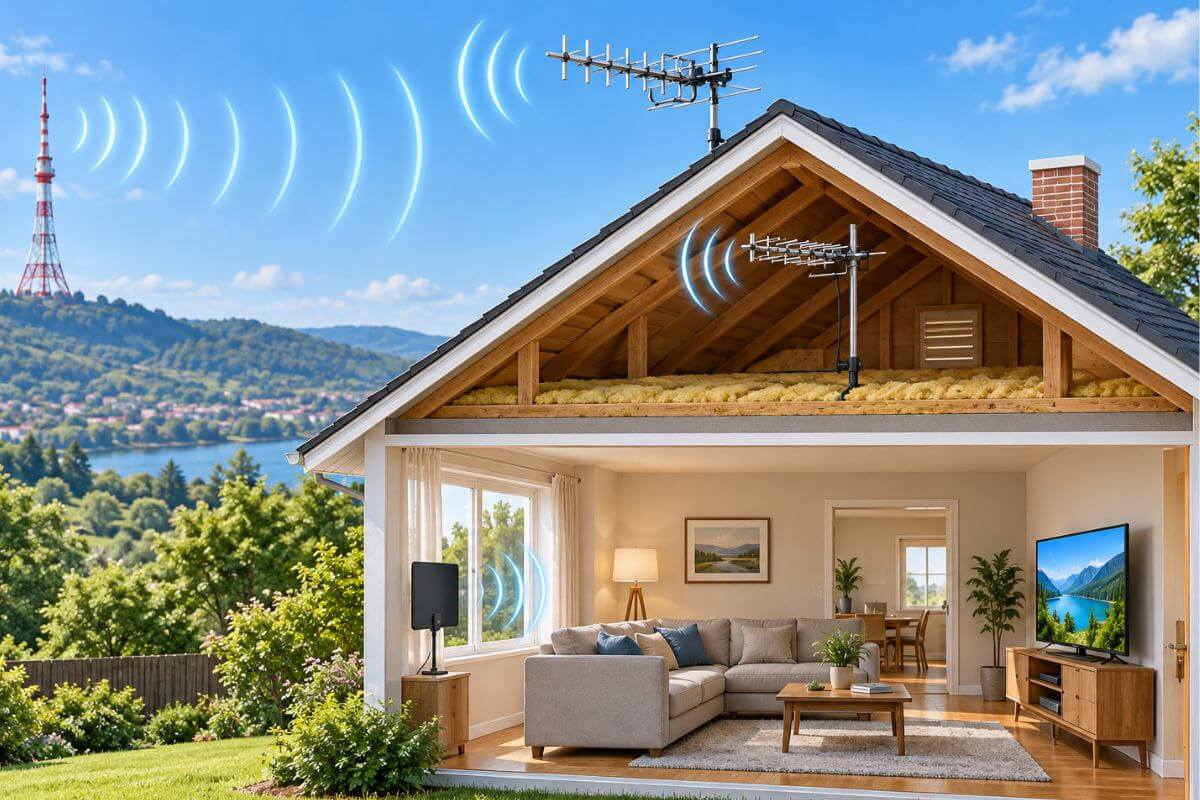
Not sure what TV antenna you need for your home? Do not choose one based only on the range printed on the box.
The right antenna depends on your local TV signals, how far you are from the towers, which direction they are in, and what may block the signal.
Follow these simple steps to decide whether you should start with an indoor, attic, or outdoor TV antenna — and whether you may need an amplifier.
Step 1: Check the TV Signals at Your Address
Start by finding the TV stations available at your home.
Go to AntennaWeb.org and enter your street address and ZIP code. Using your full address gives you a more useful estimate than entering only a ZIP code.
On the results page, look for:
- The stations you want to receive
- How many miles away each tower is
- Which direction each tower is from your home
You may also see colored antenna recommendations such as yellow, green, red, or blue. Do not worry about choosing an antenna from those colors yet. AntennaWeb uses them to describe different antenna types, including multidirectional and directional antennas.
For now, write down the stations you care about, their distance, and their direction.
Do not choose an antenna based only on mileage. Trees, hills, buildings, walls, roofing, and antenna height can all affect reception.
You will use this information in the next steps to decide whether an indoor, attic, or outdoor antenna makes the most sense for your home.
Step 2: See How Far You Are From the TV Towers
Next, look at how many miles each station is from your home.
As a simple starting point:
- Nearby towers: An indoor antenna may be worth trying first.
- Farther towers: You may need more height, which can make an attic or outdoor antenna a better choice.
- Very distant towers: Do not trust a box that promises “100-mile” reception. Distance, terrain, height, and obstacles all matter.
If the stations you want are at very different distances, pay attention to the farthest must-have station. That station may determine what type of antenna you need.
If you are hoping to use an indoor antenna, see How Far Can an Indoor TV Antenna Reach? before you buy one.
Still unsure whether moving outside would make enough difference? Compare Indoor vs Outdoor TV Antennas.
Do not make your final choice yet. In the next step, check whether your towers are all in the same direction or spread around your home.
Step 3: Check Which Direction the TV Towers Are
Now look at the direction of the towers for the stations you want.
On your AntennaWeb results, you may see several stations coming from roughly the same direction. Or the towers may be spread out in different directions around your home.
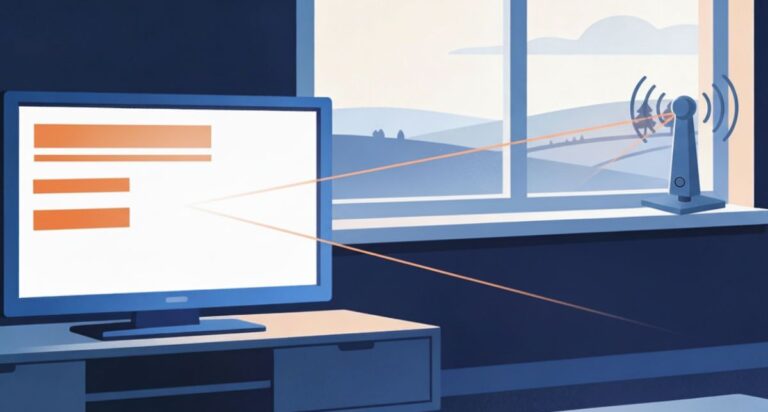
This matters because antennas receive signals differently.
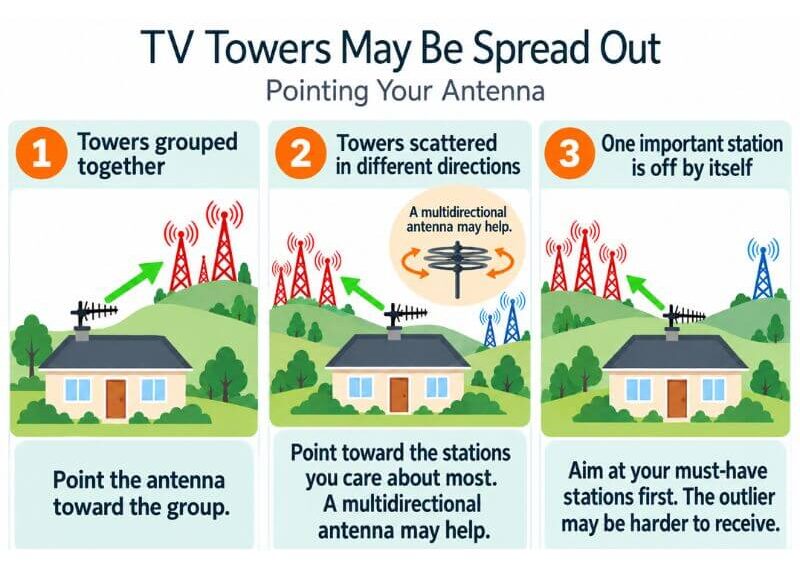
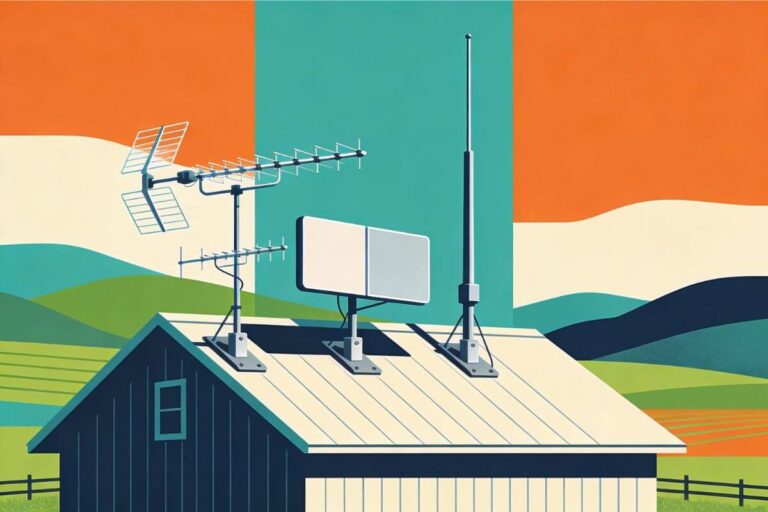
- Most towers are in the same direction: A directional antenna may work well because it can be aimed toward those towers.
- Towers are spread out: A multidirectional antenna may make more sense because it can receive signals from a wider area.
- One important station is off by itself: Make a note of it. That station may be harder to receive than the others.
Do not worry about choosing between directional and multidirectional yet. Just notice whether your must-have stations are grouped together or scattered.
If you already use an indoor antenna and want to understand how direction affects reception, see How to Aim an Indoor TV Antenna.
In the next step, check what may be standing between your home and those towers.
Step 4: Check What May Be Blocking the Signal
Two homes can be the same distance from a TV tower and still get very different reception.
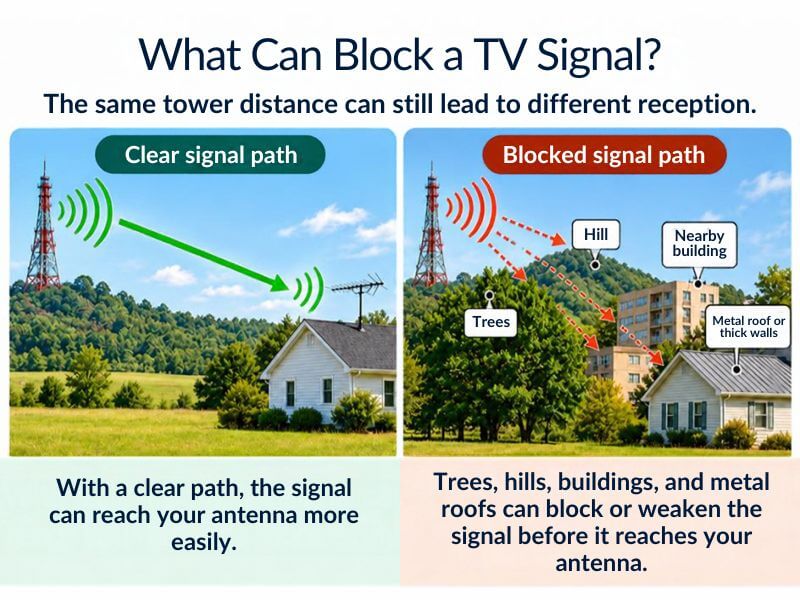
Look around your home and think about what sits between your antenna and the towers.
Common signal blockers include:
- Large trees
- Hills or uneven land
- Nearby buildings
- Brick, concrete, or metal walls
- Metal roofing
- Several walls between an indoor antenna and the towers
If your signal path is fairly open, an indoor antenna may still be worth trying.
If you have heavy tree cover, hills, thick walls, or a metal roof, getting the antenna higher can help. That may mean moving to an attic or outdoor antenna.
Do not choose a new antenna yet. In the next step, you will decide where you can realistically place one.
Step 5: Decide Where You Can Put the Antenna
Time to think about where an antenna can actually go in your home.
Your best choice may depend as much on placement as on tower distance.
- Indoor: Works best when you can place the antenna high and near a window or outside wall facing the towers.
- Attic: Gives you more height without putting the antenna outside, but roofing materials can weaken the signal.
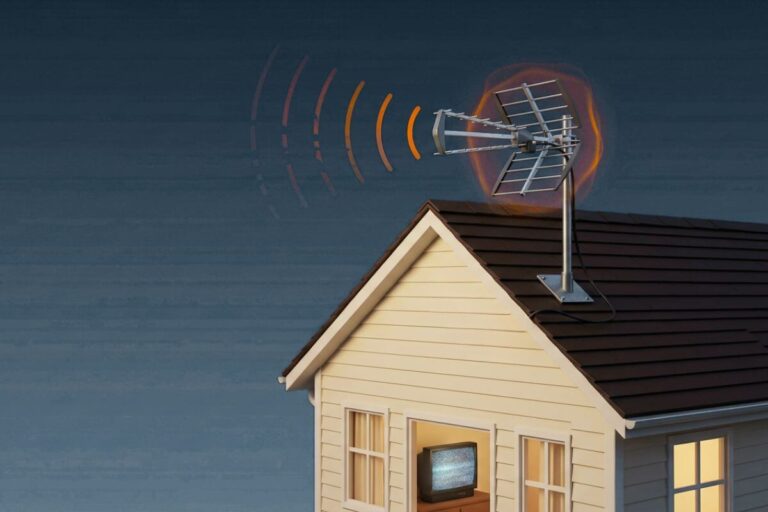
- Outdoor: Usually gives you the most height and clearest path toward the towers, but you need a safe place to mount it.
If you rent, live in a condo, or have HOA rules, your placement choices may be limited.
If an indoor antenna is your only practical option, see How to Set Up an Indoor TV Antenna for placement tips.
Next, use everything you have learned to decide whether you should start with an indoor, attic, or outdoor antenna.
Step 6: Choose the Type of TV Antenna to Try First
Now put your answers together. You are not trying to guarantee perfect reception. You are choosing the antenna type that makes the most sense to try first.
Start With an Indoor Antenna If…
- Your must-have stations have fairly strong signals.
- You have a good spot near a window or outside wall facing the towers.
- Your signal path is fairly open.
- You want the simplest setup and can test several locations.
An indoor antenna is usually the easiest place to start when signal conditions are good.
Compare Indoor TV Antennas →Consider an Attic Antenna If…
- You need more height than an indoor antenna can give you.
- You cannot or do not want to mount an antenna outside.
- Your roof is unlikely to block too much signal.
- Indoor reception is weak or unreliable.
An attic antenna can be a useful middle choice, but the roof can still weaken reception.
Compare Attic vs Outdoor Antennas →Consider an Outdoor Antenna If…
- Your important stations are farther away or weaker.
- Trees, hills, buildings, or your home block the signal.
- You need more height and a clearer path toward the towers.
- Indoor reception has already been unreliable.
An outdoor antenna usually gives you the most flexibility for height, direction, and placement.
Compare Outdoor TV Antennas →Still deciding between indoor and outdoor? See Indoor vs Outdoor TV Antennas for a side-by-side comparison.
Step 7: Decide Whether You Need an Amplifier
An amplifier is not automatically better. It cannot create a TV signal that your antenna is not receiving.
An amplifier is most useful when you already have a usable signal but some of it is being lost before it reaches your TV.
You may benefit from one if:
- You have a long coax cable run from the antenna to the TV.
- You split one antenna signal between two or more TVs.
- Channels come in at the antenna but become weak farther down the cable.
- You use an outdoor antenna and need to overcome signal loss between the roof and your TVs.
You may not need an amplifier if your towers are nearby and signals are already strong. Too much amplification can actually make reception worse.
If your main problem is that the antenna itself cannot receive a station because of distance, hills, or other obstacles, an amplifier usually will not solve it.
Think an amplifier may help your setup?
Compare the types used for weak signals, long cable runs, and multiple TVs before you buy.
Compare TV Antenna Amplifiers →Step 8: Put It All Together — What TV Antenna Do You Need?
You now have enough information to choose the type of antenna to try first.
- Choose an indoor antenna if your important stations have fairly strong signals, your path toward the towers is open, and you have a good window or outside-wall location.
- Consider an attic antenna if you need more height but cannot or do not want to mount an antenna outside, and your roof is not likely to block much signal.
- Consider an outdoor antenna if your stations are farther away or weaker, you have trees, hills, buildings, or other obstacles, or indoor reception has already been unreliable.
- Consider an amplifier only after you have a usable signal if a long cable run or several TVs are causing signal loss.
Remember: There is no antenna that can guarantee every channel at every home. Your goal is to choose the setup that gives your must-have stations the best chance of reliable reception.
Your antenna notes and quick fixes, all in one place.
Get the Free TV Antenna Troubleshooting Checklist
A 4-page fill-in guide to keep near your TV.
Fill it in once. Use it when a channel disappears, the picture breaks up, or you need to fix your antenna again.
- Write down your must-have channels, tower direction, and antenna setup
- Follow the quick fixes when a channel goes missing or the picture freezes
- Find and record your best antenna spot so you do not have to start over
- Know when to rescan — and when not to rescan
- Keep the questions to ask an antenna pro before paying for new parts

Hi, I’m Kathy — I’ve helped thousands of readers ditch cable and get their local channels working for good.
Wrap Up
The right TV antenna depends on your signals, your surroundings, and where you can place it.
Start by checking your local towers. Then use what you learned about distance, direction, obstacles, and placement to decide whether an indoor, attic, or outdoor antenna makes the most sense.
Ready to compare options? See our indoor antenna picks or outdoor antenna picks.
If you already own an antenna, do not replace it automatically. Better placement, aiming, or the right amplifier may solve the problem first.