How Far Can an Indoor TV Antenna Reach? Real-World Range
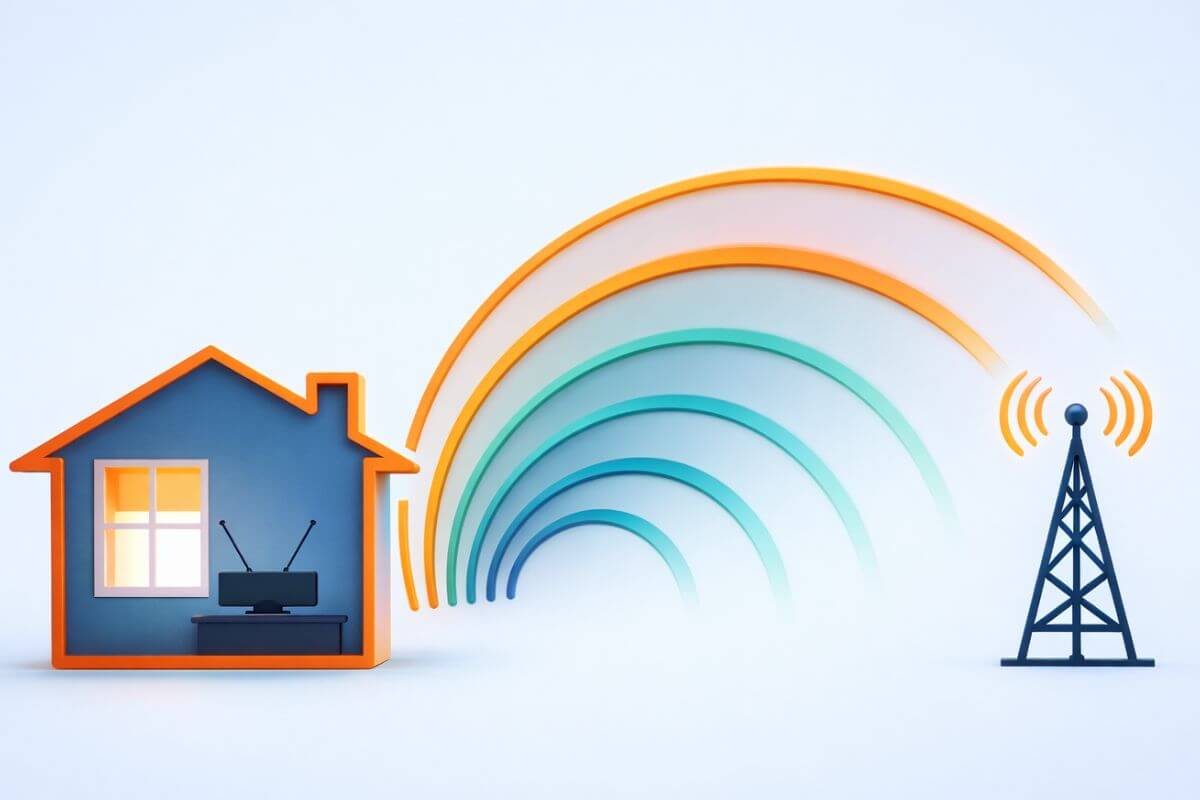
Most indoor TV antennas work best when broadcast towers are within about 20 to 40 miles. Some can work farther in strong-signal areas, but walls, trees, hills, roofing materials, and station power can reduce the usable range.
The number printed on the antenna box is only an estimate. A “50-mile” or “100-mile” antenna does not guarantee reception at that distance.
Indoor antenna range depends mostly on:
- How far you are from the broadcast towers
- Whether hills, trees, or buildings block the signal
- What your home is built from
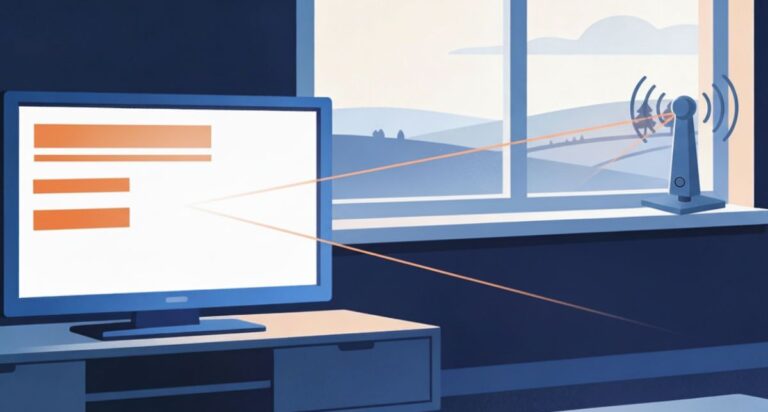
- Where the antenna is placed inside the room
- Whether the station broadcasts on VHF or UHF
If you live close to the towers and can place the antenna near a window or higher on a wall, an indoor antenna may work very well.
If you live farther away, in a wooded area, or behind hills, indoor reception may be less reliable. In that case, an attic or outdoor antenna may work better.
This guide explains what indoor antenna range is realistic, what reduces reception, and how to tell whether an indoor antenna is likely to work in your home.
Fast Fix: Indoor Antenna Range (What to Believe)
Ignore big “50-mile” or “100-mile” claims on the box. Those numbers assume very good conditions.
For most homes, indoor antennas work best when broadcast towers are within about 20 to 40 miles.
Your real range depends on four things:
- Tower distance: Closer towers usually mean stronger signals.
- Terrain: Hills and valleys can block signals.
- Obstructions: Trees, buildings, and nearby homes can weaken reception.
- Your home: Brick, metal siding, foil-backed insulation, and some roofing materials can reduce signal strength.
Quick Reality Check
An indoor antenna has a better chance of working if:
- Towers are nearby
- You can place the antenna near a window
- Your home is not heavily wooded or blocked by hills
- You can place the antenna higher on a wall or shelf
If the towers are far away or the signal must pass through heavy obstacles, an attic or outdoor antenna may be more reliable.
Bottom line: Indoor antenna range depends more on your location and signal path than the mileage printed on the package.
If you’re not sure whether indoor is enough, it helps to see how to choose the best antenna for your area based on distance.
How Far Can an Indoor TV Antenna Reach?
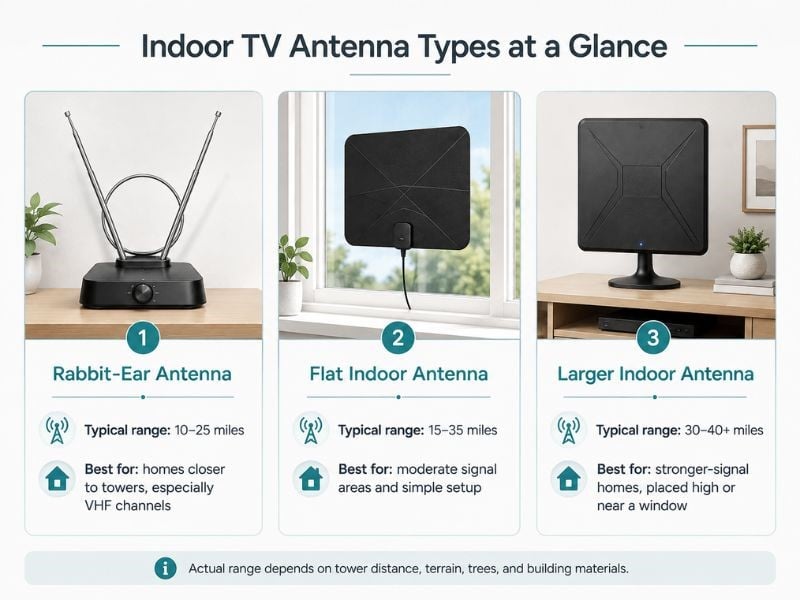
Indoor TV antennas usually work best when broadcast towers are within about 20 to 40 miles. Some can work farther in strong-signal areas, but walls, trees, hills, and building materials can shorten the usable range.
Here is a more realistic guide:
Rabbit-Ear Antennas
Rabbit-ear antennas often work well within about 10 to 25 miles of broadcast towers.
They can be especially useful for VHF stations because the metal rods can be adjusted.
Flat Indoor Antennas
Flat antennas often work best within about 15 to 35 miles.
They are easy to place near a window or on a wall, but thick walls and metal building materials can reduce reception.
Larger Indoor Antennas
Larger indoor antennas may work at 30 to 40 miles or more when signals are strong and the antenna can be placed high or near a window.
But size alone does not guarantee longer range.
What Happens Beyond 40 Miles?
Indoor reception usually becomes less predictable as tower distance increases.
If towers are farther away, or hills, trees, and buildings block the signal, an attic or outdoor antenna is often more reliable.
If you live far from broadcast towers, see my guide to the best outdoor TV antennas for rural areas.
Your antenna notes and quick fixes, all in one place.
Get the Free TV Antenna Troubleshooting Checklist
A 4-page fill-in guide to keep near your TV.
Fill it in once. Use it when a channel disappears, the picture breaks up, or you need to fix your antenna again.
- Write down your must-have channels, tower direction, and antenna setup
- Follow the quick fixes when a channel goes missing or the picture freezes
- Find and record your best antenna spot so you do not have to start over
- Know when to rescan — and when not to rescan
- Keep the questions to ask an antenna pro before paying for new parts

Hi, I’m Kathy — I’ve helped thousands of readers ditch cable and get their local channels working for good.
Why Indoor Antenna Range Can Change
An indoor antenna may work well one day and struggle the next because the signal path can change.
Common causes include:
- Trees and leaves: Dense or wet foliage can weaken signals.
- Walls and building materials: Brick, metal, insulation, and roofing can reduce indoor reception.
- Nearby buildings or obstacles: New construction or other structures can block part of the signal.
- Antenna position: Moving an antenna even a few feet can change which channels it receives.
If reception suddenly becomes worse, the antenna may not be failing. The signal reaching it may simply be weaker than before.
Why Distance and Obstacles Matter
The farther your home is from the broadcast towers, the weaker the TV signal usually becomes.
Obstacles can weaken it even more. Common problems include:
- Trees
- Hills
- Tall buildings
- Dense neighborhoods
- Metal or heavy building materials
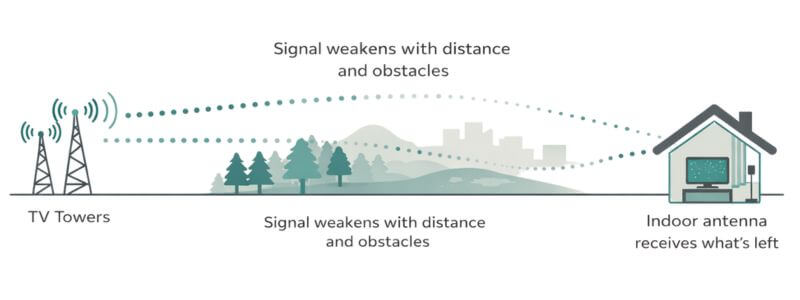
This is why two homes using the same indoor antenna can get very different results.
A home 20 miles from the towers with a clear signal path may get better reception than a home 10 miles away that sits behind hills, trees, or buildings.
How to Tell if an Indoor Antenna Will Work in Your Home
An indoor antenna has the best chance of working if:
- Broadcast towers are within about 30 miles
- Your home is not heavily wooded or blocked by hills
- You can place the antenna near a window or higher on a wall
- Large buildings are not blocking the signal
- You rescan after moving the antenna
If several of these do not apply, indoor reception may be less reliable.
If you are unsure whether an indoor antenna is enough, compare indoor vs. outdoor TV antennas.
If your antenna is already set up but channels still will not lock in, see why indoor TV antennas fail in rural areas.
Do Indoor Antennas Work in Rural Areas?
Sometimes.
An indoor antenna can work in a rural area if:
- Broadcast towers are not too far away
- Hills and trees do not block the signal
- The antenna can be placed high or near a window
- The home does not have signal-blocking materials
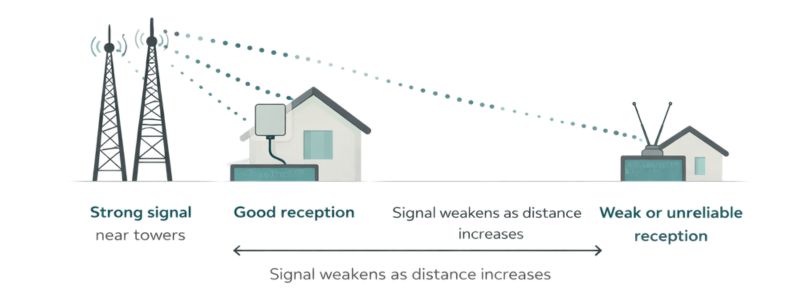
But rural homes often have weaker signals because towers are farther away and there are more obstacles between the tower and the antenna.
If your indoor antenna only works sometimes, an attic or outdoor antenna may be more reliable.
Still not sure which setup makes sense? See Indoor vs Outdoor TV Antennas for Rural Areas.
Flat Indoor Antennas vs Rabbit Ears: What’s the Difference?
Flat Indoor Antennas vs Rabbit Ears: What’s the Difference?
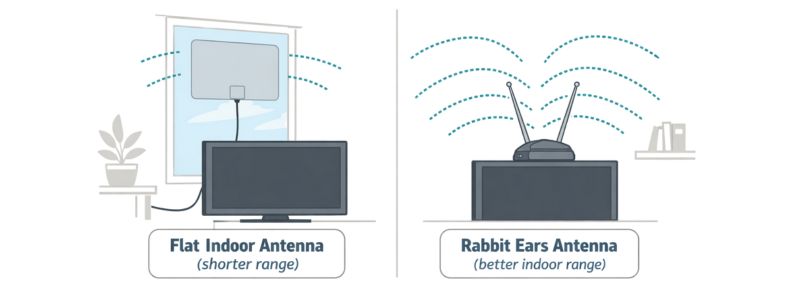
Flat indoor antennas are thin and easy to place on a wall or window.
Rabbit-ear antennas use adjustable metal rods. Because you can move the rods, they are often easier to fine-tune for weak signals.
Rabbit ears can also be better for VHF channels, while many flat antennas are designed mainly for UHF reception.
Quick Comparison
- Flat antenna: Easier to hide and simple to install
- Rabbit ears: Easier to adjust and often better for VHF
- Weak reception: Rabbit ears may give you more ways to improve the signal
Where Is the Broadcast Tower Near Me?
Before judging an indoor antenna by its advertised range, check how far your local broadcast towers actually are from your home.
AntennaWeb.org can show nearby TV stations, tower directions, and estimated signal strength.
To check your area:
- Enter your ZIP code or address.
- View the stations available near you.
- Check how far the towers are from your home.
- Note which direction the towers are located.
If most towers are within about 20 to 30 miles, an indoor antenna has a better chance of working well. Longer distances or blocked signal paths can make indoor reception less reliable.
AntennaWeb also uses colors to describe reception conditions. See its antenna information guide for an explanation of what the colors mean.
Improving Indoor Antenna Reception
If your indoor antenna is within a reasonable distance of the towers but reception is weak, try a few simple changes before replacing it.
- Move the antenna higher. A higher wall or shelf may reduce obstacles between the antenna and tower.
- Try a window. A window facing the broadcast towers often gives the signal a clearer path.
- Adjust the direction. If channels are present but unstable, learn how to aim an indoor TV antenna.
- Rescan after major changes. If a channel is missing from the TV’s saved list, run a new scan after moving the antenna. See how to set up and scan an indoor TV antenna.
If a usable signal is reaching your antenna but becomes weaker through a long cable or splitter, a TV antenna booster may help.
If these steps do not help, the problem may be distance or obstacles rather than the antenna itself.
Indoor vs Outdoor Antenna Range
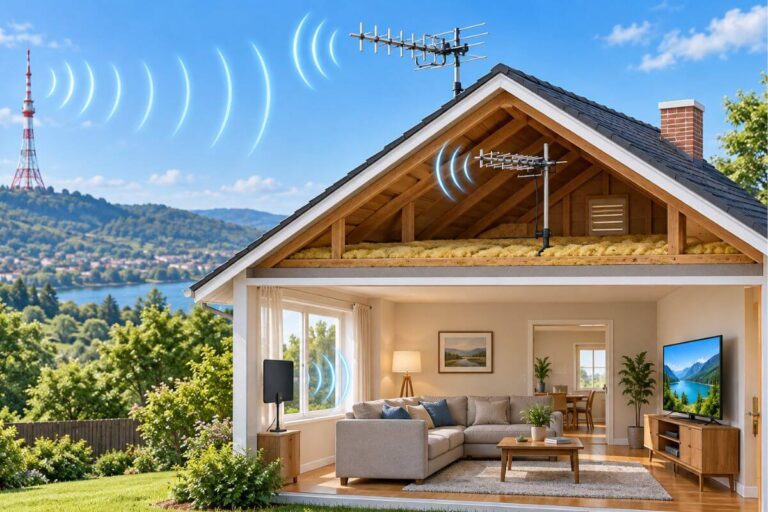
Indoor antennas work best when broadcast towers are relatively close because the signal must pass through walls, insulation, roofing materials, and other obstacles before it reaches the antenna.
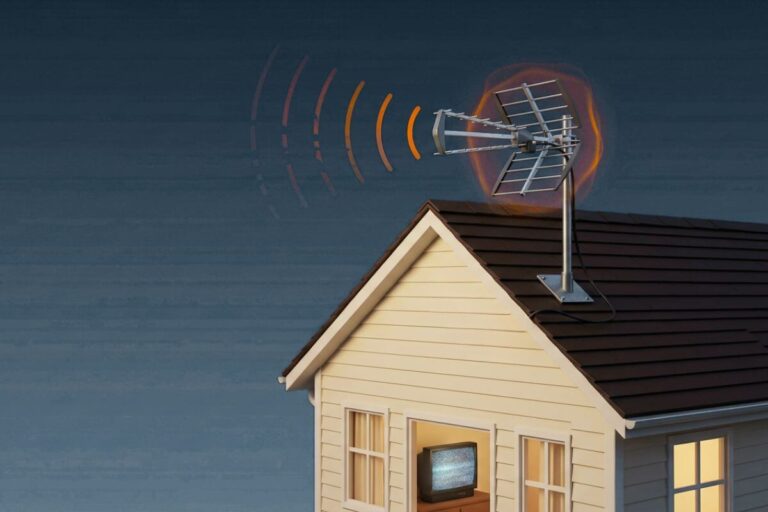
As distance increases, indoor reception becomes less reliable. Channels may freeze, disappear, or only come in at certain times.
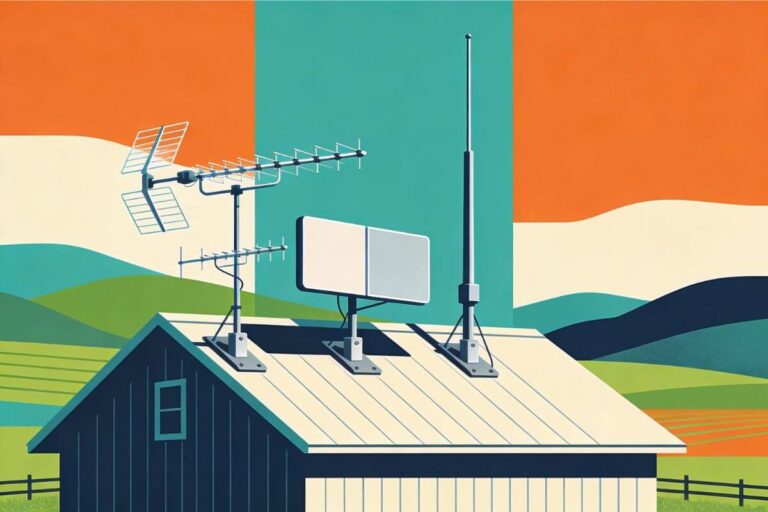
Outdoor antennas usually have an advantage because they are mounted higher and outside the home, where fewer obstacles block the signal.
In good conditions, an outdoor antenna may receive stations from 50 to 70 miles or more, but actual range still depends on terrain, tower power, antenna height, and obstructions.
If your towers are farther away or indoor reception keeps dropping out, see these outdoor antennas for rural areas.
Frequently Asked Questions
How far can an indoor TV antenna really reach?
Most indoor TV antennas work best when broadcast towers are within about 20 to 40 miles. Some may work farther when signals are strong and there are few hills, trees, buildings, or walls blocking the signal.
Can an indoor antenna work 50 miles from a tower?
Sometimes, but reception becomes less predictable at that distance. An indoor antenna may work 50 miles away if the signal is strong and the path to the tower is clear. An attic or outdoor antenna is usually more reliable at longer distances.
Do walls reduce indoor TV antenna range?
Yes. Walls can weaken TV signals before they reach the antenna. Brick, concrete, metal siding, foil-backed insulation, and some roofing materials can cause larger signal losses.
Do trees affect TV antenna range?
Yes. Dense trees can weaken or block broadcast signals, especially when the leaves are wet. Homes surrounded by trees may receive fewer channels than homes the same distance from the towers with a clearer signal path.
Are rabbit ears better than flat antennas for range?
Not always, but rabbit-ear antennas can be easier to adjust and often receive VHF channels better. Flat antennas are easy to place near a window, but some models work better with UHF signals than VHF.
Does putting an antenna near a window increase its range?
It can improve reception because the signal may pass through fewer walls and building materials. A higher window facing the broadcast towers is often one of the best places to test an indoor antenna.
Can an amplifier increase indoor antenna range?
An amplifier can strengthen a signal that is already reaching the antenna, but it cannot create a signal that is not there. It is most useful when signal is lost through long coaxial cable runs or splitters.
When should I switch from an indoor to an outdoor antenna?
Consider an outdoor antenna when towers are far away, hills or trees block the signal, or indoor reception remains unreliable after trying several antenna positions. Outdoor antennas usually perform better because they can be mounted higher and avoid many indoor obstacles.
Wrap Up
Indoor TV antennas work best when broadcast towers are relatively close and the signal has a clear path into your home.
For many homes, about 20 to 40 miles is a more realistic indoor range than the large mileage claims printed on antenna packages.
Your actual results depend on:
- Tower distance
- Hills and trees
- Building materials
- Antenna type
- Antenna placement
If you live outside town, see my guide to the best indoor TV antennas for rural areas.
If moving the antenna higher or closer to a window does not improve reception, an attic or outdoor antenna may be a better choice.