5 Best Indoor TV Antennas for Rural Areas (2026 Guide)
Finding the best indoor TV antennas for rural areas in 2026 depends entirely on three factors: Your distance from broadcast towers, whether you need tricky VHF channels, and how much trees or hills block your line of sight.
For most rural homes, start with a realistic indoor option before moving to an attic or outdoor antenna. Cheap flat antennas with huge range claims usually disappoint in weak-signal areas.
Quick Answer: Best Indoor TV Antennas for Rural Areas
- Under 25 miles, try the Channel Master FLATenna 35 or Philips Rabbit Ears.
- Around 30–40 miles, try the Winegard FlatWave Amped or Mohu Leaf Supreme Pro.
- Near 40–70 miles, the Antennas Direct ClearStream 4V is the strongest indoor/attic-style option, but many rural homes will eventually need an attic or outdoor antenna.
This guide compares the best realistic indoor antenna choices for rural homes and explains when indoor reception is no longer enough.
Best Indoor TV Antennas for Rural Areas by Distance
The best indoor TV antenna for a rural area depends on distance from towers. Under 25 miles, a basic model like the Channel Master FLATenna 35 or Philips Rabbit Ears can work. Around 30–40 miles, try the Winegard FlatWave Amped or Mohu Leaf Supreme Pro. Near 40–70 miles, the ClearStream 4V is the strongest indoor/attic-style option, but many homes will need an attic or outdoor antenna.
Our Picks: Best Indoor TV Antennas for Rural Areas
These models consistently outperform generic flat antennas in real rural and weak-signal homes.
If you already know your situation, click any pick below to jump straight to the full review. These indoor antennas are grouped by the problem they solve best: budget, VHF channels, weak signals, larger homes, and near-the-limit rural reception.
Best Budget Option – Channel Master FLATenna 35
Best for VHF Channels – Winegard FlatWave Amped
Best Large Indoor Antenna – Mohu Leaf Supreme Pro
Best Indoor Antenna for Rural Homes (Near the Limit) – Antennas Direct ClearStream 4V
Best Traditional Design – Philips Rabbit Ears Indoor Antenna
This page contains affiliate links. If you buy through them, I may earn a small commission at no extra cost to you.
Before you buy an indoor antenna, check your local channels first. The free checklist helps you test your signal, choose the right setup, and avoid wasting money on the wrong antenna.
Get the free local channel checklist before you choose an antenna.
⛔ Stop! Check Your Local Channels Before You Buy
“Before you spend $30 to $100 on a new indoor antenna, make sure it can actually catch your local stations. Download our free 10-Page TV Antenna Guide to map your local towers, see if you need a VHF setup, and avoid wasting money on the wrong equipment.”
How We Chose the Best Indoor TV Antennas
I did not personally test every indoor antenna on the market in my home. Instead, I built this list using a practical screening process focused on real-world weak-signal performance, not box claims.
To choose these five antennas, I compared:
- independent antenna test results (VHF/UHF performance and consistency)
- long-term owner feedback in weak-signal areas
- setup reliability and common failure patterns (overload, poor VHF, flimsy cables)
I excluded models that rely on exaggerated “100–1000 mile” range claims or perform inconsistently outside strong urban signal areas.
Each antenna had to meet these criteria:
- Works better in weak/blocked signal homes (trees, hills, heavy walls)
- Strong VHF + UHF support (important for many rural markets)
- Amplifier behaves predictably (helps when needed, but can be used turned off)
- Flexible indoor placement (window/wall/shelf/attic)
- Simple setup (simple connections, stable results after rescans)
Result: These are indoor antennas that give rural homes the best realistic chance of stable reception — before moving up to attic or outdoor antennas.
What are the Best Indoor TV Antennas for Rural Areas?
1. Channel Master FLATenna 35 — Best Budget Option
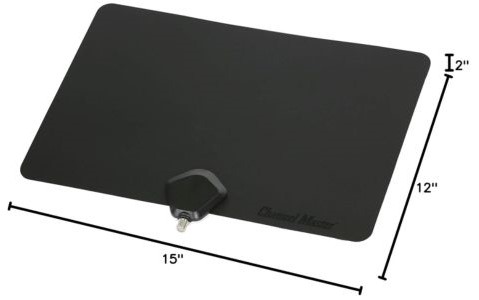
The Channel Master FLATenna 35 is a small, strong flat antenna that beats many cheaper no-name models.
Reality check: This works best when towers are relatively nearby — it’s not meant for deep-rural or mountain terrain.
Features:
Flat reversible design, detachable thick RG6 cable, 35-mile rating, clean look. Can be mounted on a wall or window.
Benefits to You:
- Very affordable
- Thick cable reduces signal loss
- Easy for seniors to set up (plug and scan)
Pros:
- Under $30
- Great VHF performance
- Better than most antennas twice the price
- Reliable across multiple tests
Cons:
- No amplifier included
- Stiff cable
- Limited range for rural mountains
Bottom Line:
This is the indoor antenna I’d try first if you are rural but not extremely far from towers. It is simple, inexpensive, and less gimmicky than many flat antennas with inflated range claims. The downside is that it will not solve deep-rural reception problems, so treat it as a smart first test — not a miracle fix.
Best if you want a low-cost indoor antenna for a rural home that is still fairly close to broadcast towers.
2. Winegard FlatWave Amped — Best for VHF Channels
The Winegard FlatWave is one of the best all-around indoor antennas for mixed terrain.
Reality check: Try it with the amplifier off first — many homes don’t need the extra boost.

Features:
Amplified, 55-60 mile range, long 18.5 ft cable, USB-powered amp.
Benefits to You:
- Excellent performance on VHF (7–13)
- Long cable helps find the best spot
- USB amp saves outlet space
- Reduces pixelation in weak areas
Pros:
- Consistently clear picture and sound
- Flexible placement
- Good build quality
Cons:
- Amp not always needed
- Pricier (under $100)
- Sometimes performs same as cheaper units
Bottom Line:
This is the better choice if VHF channels matter in your area or if your signal is weak enough that an amplifier might help. I like that you can test it with the amplifier off first, then turn it on only if needed. That makes it more flexible than cheaper amplified antennas that force you into one setup.
Best if your area uses VHF channels or you want an amplified antenna you can test with the booster on or off.
3. Mohu Leaf Supreme Pro — Best Large Indoor Antenna
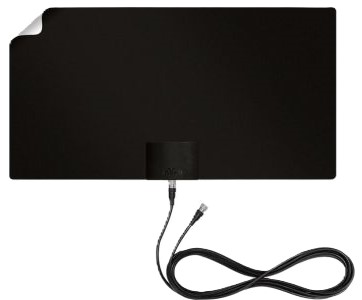
The Mohu Leaf Supreme Pro is a larger flat indoor antenna with more surface area than many basic leaf-style models.
Reality check: Bigger antennas work better, but you’ll need wall or window space.
Features:
12″x21″ size, signal indicator lights, long range, detachable amp.
Benefits to You:
- Bigger surface pulls in more weak signals
- Indicator helps you find the exact sweet spot
- Excellent HD clarity
- Stable long-range performance
Pros:
- Four times the capture area of typical leaf antennas
- Very good rural performance
- Premium materials
Cons:
- Large footprint
- Higher price ($69)
Bottom Line:
This is the pick I’d consider if you want a stronger flat antenna but still want something that looks clean on a wall or window. The larger surface area gives it a better shot in weak-signal homes than tiny paper-thin models. It is not the cheapest option, so it makes the most sense if placement space is not a problem.
Best if you want a larger flat antenna with more surface area for weaker indoor signals.
4. Antennas Direct ClearStream 4V — Best Indoor Antenna for Rural Homes (Near the Limit)
The Antennas Direct ClearStream 4V offers powerful multi-directional design.
Reality check: It is overkill for close-in homes, but a lifesaver farther out.
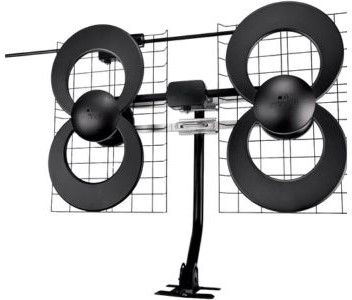
Features:
Four-loop system, 70-mile rating attic use, UHF + VHF, indoor/attic/outdoor use.
Benefits to You:
- Excellent in tough rural environments
- Can be used indoors now, outdoors later
- Picks up stations others miss
- Very durable
Pros:
- Outstanding long-range results
- Multi-directional
- Works well even with trees/hills
- Lifetime warranty
Cons:
- Requires assembly
- Larger than flat antennas
- Costs more ($89–105)
Bottom Line:
This is the strongest “indoor” option on the list, but it is really best for people who are already close to needing an attic or outdoor setup. I like it because you can start indoors and move it later instead of buying another antenna. It is bigger and less discreet than a flat antenna, but that is part of why it works better near the edge of indoor reception.
Best if you are near the limit for indoor reception and want an antenna that can move to an attic or outdoor mount later.
5. Philips Rabbit Ears Indoor Antenna — Best Traditional Design
The Philips Rabbit Ears Indoor Antenna offers old-time style with excellent VHF performance.
Reality check: Placement and adjustment matter more than looks with this one.

Benefits to You:
- Great for channels many flat antennas struggle with
- Super easy to adjust
- Very cheap ($11–16)
- Sits neatly on tables or TV stands
Pros:
- Excellent VHF performance
- Simple setup
- Very affordable
Cons:
- Old-fashioned look
- Limited range
- Short cable
Bottom Line:
This is the simple, low-cost option for homes that are not too far from towers, especially where VHF channels matter. It will not win any style awards, but rabbit ears still work well in the right location. If you are close enough to towers and want the easiest setup, this is a practical choice.
Best if you are close to towers and want a simple, inexpensive antenna that handles VHF channels well.
Before You Buy: Quick Placement Test
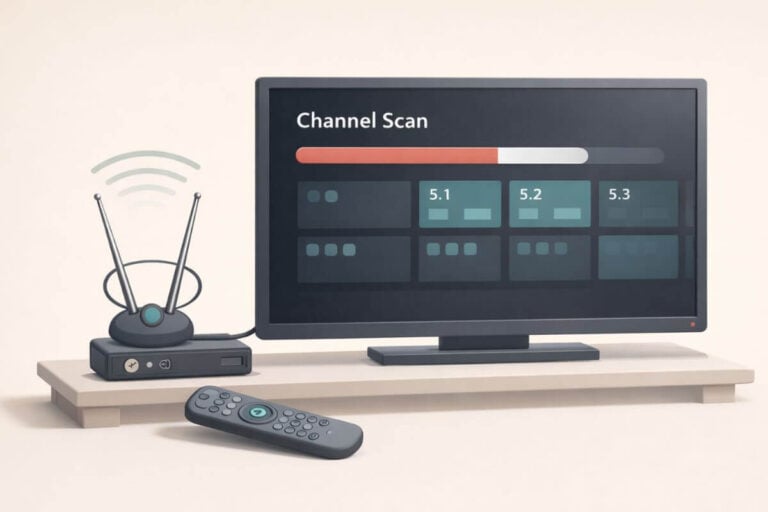
Before replacing your antenna, test it in the best possible spot. Place it high, near a window, or on an outside wall facing your broadcast towers. Then run a full channel scan.
Move the antenna 2–3 feet, try one more window or higher shelf, and scan again. If channels still freeze, pixelate, or disappear, the issue may not be the antenna model. In many rural homes, the real fix is moving up to an attic or outdoor antenna.
Tip: If you’re using a streaming device, make sure you’re scanning on the TV’s antenna input, not inside the app.
Choosing the Right Antenna (at a Glance)
- Under ~25 miles + few obstructions: FLATenna 35 or Philips Rabbit Ears
- ABC/PBS (VHF) matters: Winegard (or Philips for VHF)
- ~30–40 miles: Winegard or Mohu (test amp OFF, then ON)
- ~40+ miles: ClearStream 4V (best indoor “last chance,” can move to attic later)
- 70+ miles + trees/hills/valley: Skip indoor — go attic or outdoor
If you are not sure whether indoor, attic, or outdoor makes sense, start with this simple guide to choosing the right TV antenna for your area.
Why Rural Homes Need Different Antennas Than Cities
- Rural TV reception is harder because your signal has to travel farther and pass through more obstacles before it reaches your home. Three factors matter most:
- Distance from broadcast towers: The farther you are from transmitters, the weaker the signal arrives at your antenna.
- Trees and heavy foliage: Leaves, branches, and dense woods absorb and scatter TV signals.
- Hills and uneven terrain: Ridges, valleys, and rising land can block or reflect signals before they reach your roof or window.
- If your channels are spotty or pixelated, small positioning changes can make a big difference. For step-by-step guidance, see our guide on how to aim an indoor TV antenna to get the strongest signal from your location.
Rural Reality Check: When Indoor Stops Working
Indoor antennas can work in rural areas up to a point. If you’re far from towers or blocked by hills/trees, the signal is often too weak and unstable for any indoor model to hold consistently.
If you’ve tried high placement near a window and still get freezing, missing channels, or weather-related dropouts, it may be time to compare an attic or outdoor antenna instead of buying another indoor model. This upgrade isn’t about spending more — it’s about getting above obstructions.
Do You Need an Amplifier for an Indoor Antenna?
Amplifiers can help — but they can also make reception worse. Our guide to antenna boosters walks you through when an amplifier is a good idea and when it isn’t.
Use this rule every time:
- Run a channel scan with the amplifier OFF
- If channels are missing, freezing, or pixelating → turn it ON and rescan
- If reception gets worse → turn it back OFF
That means your TV tuner is overloaded.
Bottom line:
Amplification is a troubleshooting tool — not a default setting.
What You Can Watch With an Indoor Antenna
An indoor antenna pulls free local channels over the air — no subscription and no internet required. If your goal is replacing cable, this guide explains how to cut TV cable while keeping free local channels.
Depending on your location, you may get:
- ABC, CBS, NBC, FOX, PBS
- Local news and weather
- Live sports on major networks
- Extra subchannels (where many classic TV channels live)
Avoid These “Too Good to Be True” Claims
- “100–1000 mile range”: not realistic indoors
- “4K antenna”: marketing; broadcast quality determines resolution
- “Wireless antenna”: usually a network tuner box that still uses coax
Quick shopping rule: Stick to recognizable brands (Channel Master, Winegard, Mohu, Antennas Direct, Philips) and ignore extreme range claims.
Where to Buy Indoor TV Antennas
For rural homes, buy from a retailer with easy returns because indoor antenna results vary by house, tower distance, trees, walls, and placement. Amazon gives the widest selection, while Walmart, Target, and Best Buy can be useful if you want to test something quickly and return it locally.
Frequently Asked Questions
What is the best TV antenna at Walmart?
Walmart can be a good place to buy an indoor antenna mainly because returns are easy, which matters a lot in rural and weak-signal homes (performance varies by house and placement).
In most stores, the safest picks are name brands you recognize—often Philips (rabbit ears and flat styles) and sometimes RCA. Some locations may also stock higher-end brands, but selection can vary by store and online listings.
What to avoid at Walmart: Very cheap, no-name antennas claiming 150–1000 mile range or pushing “4K antenna” as if it improves reception. Those claims are usually inflated, and the antennas tend to perform inconsistently.
Best approach: Buy a name-brand model, test it in the best placement (high/window), rescan channels, and if it underperforms, return it and move up to a stronger model—or consider an attic/outdoor antenna if you’re 70+ miles out or heavily blocked by trees/hills.
How do I use an antenna for old TV sets?
To use an antenna for old TV sets made before 2009, you need a digital converter box. Connect your antenna to the converter box’s “ANT IN” port, then connect the converter box to your TV using RCA cables (yellow, red, white).
If your old TV only has screw terminals (VHF/UHF), you’ll also need a matching transformer to connect the converter box’s coaxial output to those terminals.
Tune your TV to the correct input (Video, AUX, or the channel set on your RF modulator), then use the converter box remote to scan for channels and change stations.
Does an indoor TV antenna work for rural areas?
Yes, but with limitations. Indoor antennas usually work best within about 30–50 miles of towers, depending on terrain and obstructions. If you’re 60+ miles out, you’ll get better results with an outdoor antenna mounted on your roof or in your attic.
Options include amplified models like the Winegard FlatWave Amped, Mohu Leaf Supreme Pro, or Antennas Direct ClearStream 4V.
Terrain matters too. Hills, trees, and buildings between you and the towers block signals. Higher placement helps—try upstairs windows or attic installation.
How do I improve an indoor TV antenna signal in a weak-signal home?
To improve indoor tv antenna signal, follow these steps in order:
– Move the antenna closer to a window facing your TV towers. Use antennaweb.org to find tower locations.
– Try higher placement—near the ceiling or on a second floor.
– Keep it away from electronics like routers, microwaves, and computers.
– Use a quality RG6 coaxial cable if you need an extension.
– Add an amplifier only if needed. Try without it first—over-amplifying strong signals makes things worse.
– Rescan your TV channels after each adjustment.
– If you’re still struggling after trying these steps, you might need an outdoor antenna.
Do indoor TV antennas pick up digital TV channels?
Yes, absolutely. All modern antennas, including indoor models, pick up digital TV antenna for local channels. TV stations broadcast in digital format since 2009.
Your antenna receives the digital signals, and your TV’s built-in tuner decodes them. You’ll get networks like ABC, CBS, NBC, Fox, PBS, and many more—all in HD quality, completely free.
The term “digital antenna” is mostly marketing. Any antenna made in the last 20 years works with digital broadcasts. Even old rabbit ears from the 1980s still work because digital signals use the same frequencies as old analog signals did.
Is a 4K indoor TV antenna better than a regular one?
No. An indoor 4 K TV antenna is the same as any other antenna. “4K ready” is a marketing term.
Here’s the truth: Antennas don’t determine picture quality—the broadcast does. If a station broadcasts in 4K (very few do as of 2025), any antenna can receive it. The antenna just catches radio waves.
Your TV’s tuner and screen determine whether you see 4K, HD, or standard definition. A $20 antenna works exactly the same as a “$60 4K antenna” for receiving signals.
Don’t pay extra for “4K” labels on antennas. Focus instead on range, amplification, and brand quality.
Does a wireless indoor TV antenna work well?
A indoor TV antenna wireless setup can work well, but it’s not actually wireless in the way most people think.
You still need a regular antenna connected by coaxial cable to a special network tuner box (like HDHomeRun, Tablo, or AirTV). That box connects to your home WiFi router. Then you watch TV through apps on your streaming devices.
Benefits:
– Place your antenna in the best spot regardless of where your TVs are
– Watch on multiple TVs without running cables through walls
Drawbacks:
– Costs $100-200 for the network tuner box
– Requires good WiFi signal throughout your home
– Adds complexity—more devices to set up and troubleshoot
– For most people with one or two TVs, a regular coaxial cable is simpler and cheaper. Wireless tuners make sense for multi-TV homes or if your best antenna spot is far from your TVs.
Wrap Up
The best indoor TV antenna for a rural home depends on tower distance, obstructions, and how weak the signal is before it reaches your house.
For homes within about 20–40 miles of broadcast towers, a good indoor antenna may be enough if you place it high, near a window, and rescan after each move. For homes farther out, blocked by trees, or surrounded by hills, indoor reception may stay unreliable no matter which model you buy.
Start with a realistic indoor option if your signal is close enough. But if channels keep freezing, pixelating, or disappearing, an attic or outdoor antenna is usually the more dependable fix.