8 Best Outdoor TV Antennas for Rural Areas and Weak Signals
The best outdoor TV antenna for most rural areas is the ClearStream 4V. For very weak signals from distant towers, I prefer the Televes DAT BOSS Mix LR. If you need Low-VHF channels, choose the Winegard HD8200A.
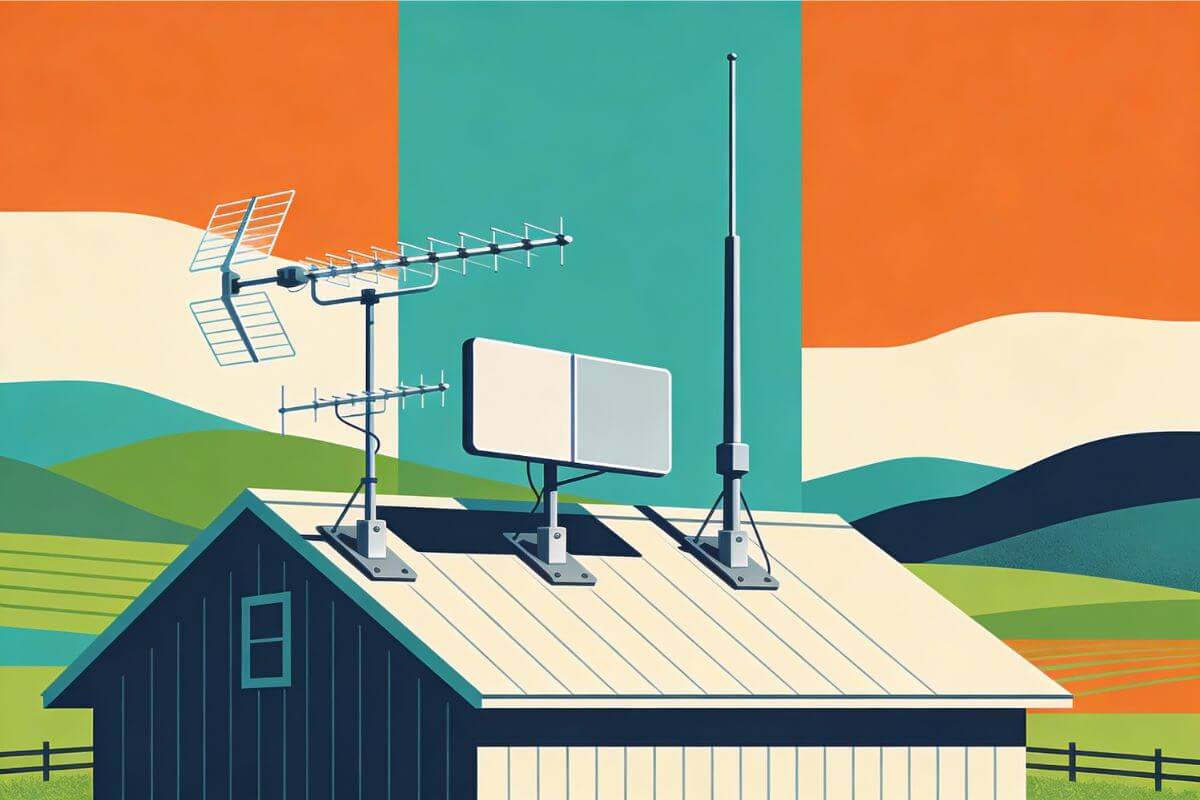
For most rural homes, a directional antenna provides the strongest signal. If towers are in several directions, a multi-directional or omnidirectional antenna may work better.
Quick guide:
- 50+ miles: High-gain directional antenna
- 20–50 miles: Directional or multi-directional antenna
- Under 20 miles: Multi-directional or omnidirectional antenna
These distances are only a starting point. Hills, trees, antenna height, and tower direction can change what works at your home.
Before choosing an outdoor model, it helps to understand when you actually need an outdoor antenna based on your location.
Quick Picks
Choose the antenna that best matches your distance, tower direction, channel frequencies, and number of TVs.
| Best For | Our Pick | Works Best When | Check It |
|---|---|---|---|
| Best overall | ClearStream 4V | You want strong UHF and Hi-VHF reception with less difficult aiming | View on Amazon |
| Weak rural signals | Televes DAT BOSS Mix LR | Distant Hi-VHF and UHF towers are mainly in one direction | View on Amazon |
| Low-VHF and long range | Winegard HD8200A | You need Low-VHF, Hi-VHF, and UHF reception from distant towers | View on Amazon |
| Multiple TVs | ClearStream MAX-XR Complete | You want one complete system for as many as three TVs | View on Amazon |
| Distant UHF signals | DB8-e Bowtie | Distant UHF towers are in one or two directions | View on Amazon |
| Towers in every direction | Channel Master Omni+ 50 | Signals are fairly strong and towers surround your home | View on Amazon |
| Hi-VHF channels | ClearStream 5 | Important channels use Hi-VHF frequencies | View on Amazon |
| Budget buyers | Antennas Direct ELEMENT | Towers are at a moderate distance in one main direction | View on Amazon |
This page contains affiliate links from participating retailers. If you buy through one of these links, I may earn a commission at no extra cost to you. As an Amazon Associate I earn from qualifying purchases.
Not sure which type you need? See how to choose a TV antenna based on your location.
What Is the Best Outdoor TV Antenna for Rural Areas?
For many rural homes, my top pick is the ClearStream 4V. It receives UHF and Hi-VHF channels but does not include an amplifier.
The right choice depends on where your towers are and which channels you want.
Compare the picks below to find the best fit for your home:
ClearStream 4v – Best Overall Outdoor Antenna
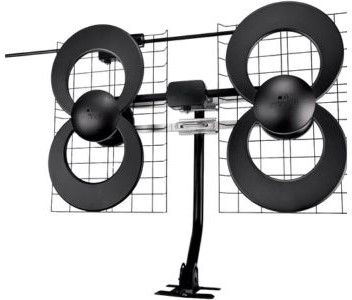
The ClearStream 4V is my overall pick for rural homes where an indoor antenna is not enough. It receives UHF and Hi-VHF channels and can be mounted outdoors or in an attic. Reception depends on your local signals, tower direction, and mounting spot. For very weak signals from towers mainly in one direction, consider the Televes DAT BOSS Mix LR, below, instead.
Key Features
- Multi-directional design
- UHF + VHF reception
- Indoor, attic, or outdoor mounting
- Includes 20-inch mast
- Two-loop design
- Light, simple build
Pros
- Strong real-world performance up to ~70 miles
- Less aiming than directional antennas
- Flexible installation options
Cons
- No amplifier included
- Not ideal for extreme fringe distances
- Larger than compact outdoor antennas
Bottom Line
For most rural households, this antenna hits the sweet spot between performance and simplicity. The ClearStream 4v pulls in signals from multiple directions without the hassle of precise aiming, making it easier to install and live with long-term.
It performs reliably up to about 70 miles from broadcast towers and works well mounted outdoors or in an attic, offering a clear step up from indoor antennas without unnecessary complexity.
Best if you want a strong, simple outdoor antenna for rural or fringe areas without complicated aiming.
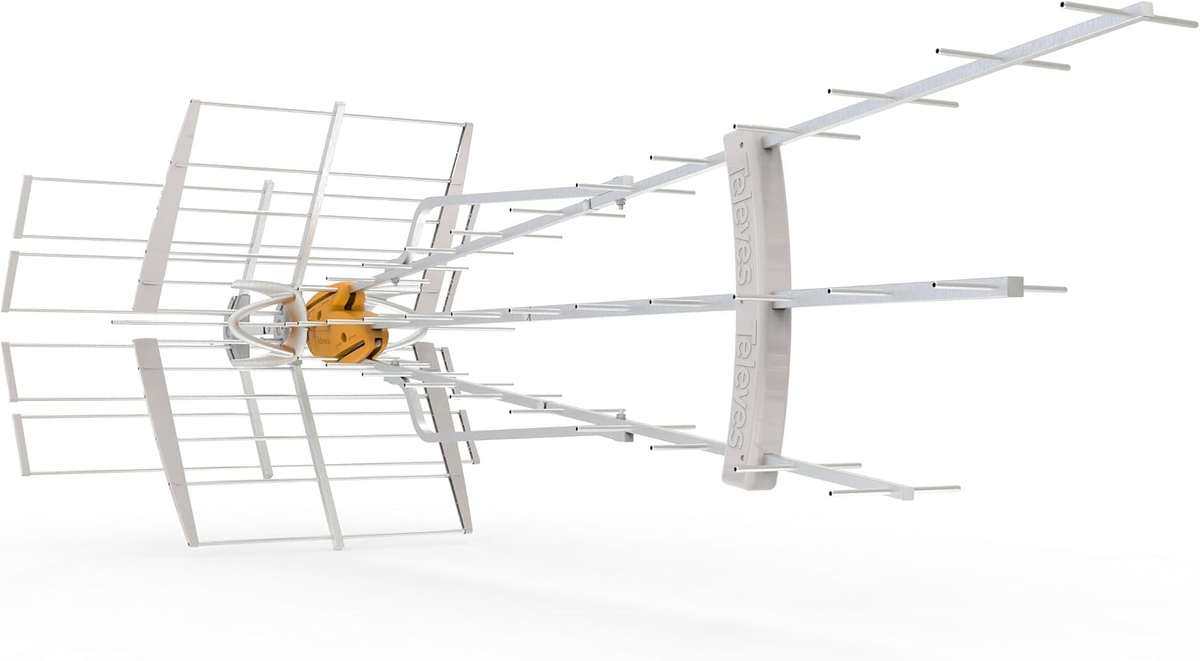
Televes DAT BOSS Mix LR – Best for Weak Rural Signals
The Televes DAT BOSS Mix LR is our best overall pick for rural homes with weak or changing signals. This directional antenna receives UHF and Hi-VHF channels. Its built-in amplifier adjusts itself to strengthen weak signals without overloading stronger ones.
Key Features
- Directional UHF and Hi-VHF reception
- Built-in TForce amplifier
- Automatic gain adjustment
- FM, LTE, 4G and 5G filtering
- Power supply included
- Weather-resistant outdoor design
Pros
- Strong performance in rural and weak-signal areas
- Adjusts amplification automatically
- No separate preamplifier needed
- Filters common sources of interference
- More compact than many large long-range antennas
Cons
- More expensive than basic outdoor antennas
- Must be aimed toward the broadcast towers
- Does not receive Low-VHF channels 2–6
- The amplifier needs power for full performance
Bottom Line
Choose the Televes DAT BOSS Mix LR when your towers are far away and located mainly in one direction. Its directional design captures weak signals, while the built-in amplifier adjusts the signal level as reception conditions change.
It receives both UHF and Hi-VHF channels, which covers most local TV stations. However, choose a different antenna if your area uses Low-VHF channels or your towers surround your home.
Best if you live in a rural or weak-signal area and need strong UHF and Hi-VHF reception from distant towers in one direction.
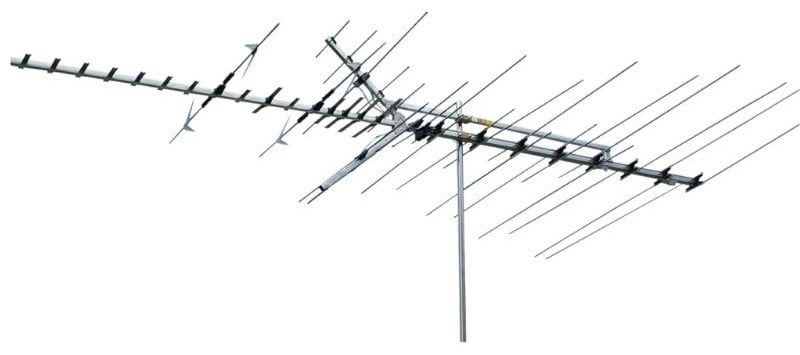
Winegard HD8200A – Best for Low-VHF, High-VHF, and UHF Reception
The Winegard HD8200A is a large outdoor antenna for homes that need Low-VHF, High-VHF, and UHF reception. Winegard lists a range of 65+ miles, but your results depend on your location, nearby trees, hills, and antenna height.
This directional antenna works best when the towers you need are mainly in the same direction. It needs a sturdy mount and careful aiming. It does not have a built-in amplifier.
Key Features
- Receives Low-VHF, High-VHF, and UHF signals
- Manufacturer-rated range of 65+ miles
- Directional design aimed toward broadcast towers
- Non-amplified
- Built for outdoor use, with weather and rust resistance
Pros
- Covers all three TV frequency bands
- An option for rural homes far from towers
- Useful when a station you want uses Low-VHF
Cons
- Large size requires room for installation
- Needs a sturdy mount and careful aiming
- May be more antenna than your home needs
- The stated range does not guarantee reception
Bottom Line
Choose the Winegard HD8200A if you need an outdoor antenna that receives Low-VHF, High-VHF, and UHF signals. Check your local stations’ signal bands to make sure it fits your needs.
Best for rural homes that need all three TV bands, including Low-VHF, from towers mainly in one direction.
ClearStream MAX-XR Complete – Best for Multiple TVs
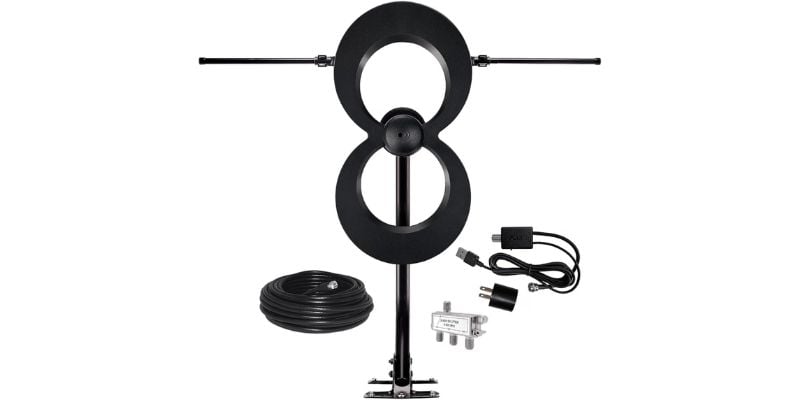
The ClearStream MAX-XR Complete includes an antenna and several parts needed to send its signal to as many as three TVs. It is a useful choice if you want fewer parts to buy separately.
Key Features
- Receives UHF and Hi-VHF channels
- Includes a 20-inch mast and mounting hardware
- Includes a 30-foot coax cable
- Includes a Jolt Switch amplifier and USB power adapter
- Includes a 3-way splitter
Pros
- Several setup parts come in one box
- Can feed up to three TVs
- Amplifier can help reduce signal loss from cables and splitting
Cons
- Does not cover Low-VHF channels
- You may need extra coax cables to reach each TV
- Outdoor grounding parts and installation may cost extra
- Reception still depends on your location and antenna placement
Bottom Line
Choose the ClearStream MAX-XR Complete if you want one antenna to serve several TVs. Check your local signals and measure your cable runs before buying.
Best for homes that want one outdoor antenna to serve up to three TVs, with several setup parts included.
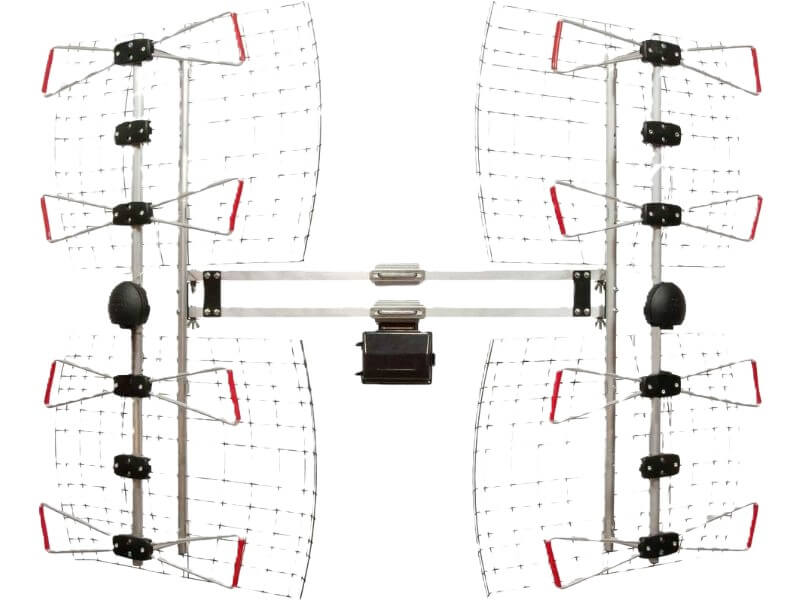
DB8-e Bowtie – Best for Distant UHF Signals
The DB8-e Bowtie Antenna is a high-gain eight-bay antenna designed to pull in very weak UHF signals from long distances. Its large bowtie array captures signals that smaller outdoor antennas often miss, making it a strong choice for rural areas where broadcast towers are far away and standard antennas struggle to hold a stable signal.
Key Features
- 8-element UHF bowtie array
- Adjustable multi-directional panels
- Extremely high UHF gain
- Outdoor or attic mount
Pros
- Excellent long-range UHF performance
- Adjustable for tower direction
- Proven rural reception
Cons
- UHF-only (no VHF)
- Large physical size
Bottom Line
When distant UHF stations are the priority, the DB8-e delivers the kind of raw performance smaller antennas can’t match. Its high-gain design is well suited for rural locations where signals are weak and distance matters. If you’re trying to reach fringe UHF channels that other antennas miss, this model is built for exactly that job.
Best if your main problem is pulling in weak, distant UHF stations from rural broadcast towers.
Channel Master Omni+ 50 – Best Omnidirectional Outdoor TV Antenna
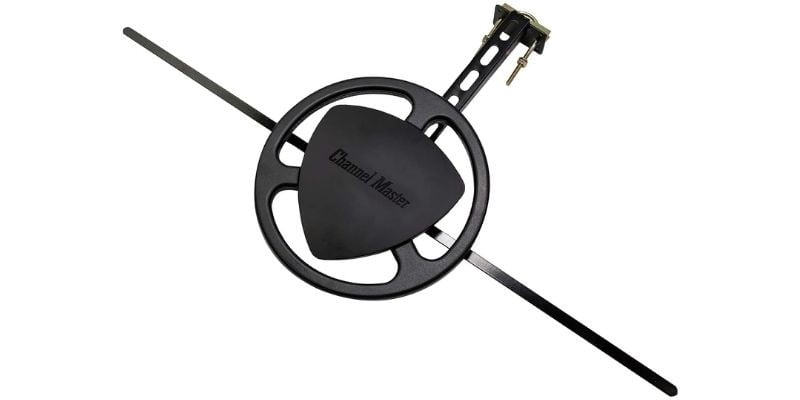
The Channel Master Omni+ 50 is best for homes with broadcast towers in several directions. Its omnidirectional design receives signals from all sides, so you do not need to aim it toward one group of towers. It receives UHF and VHF channels and is designed for locations up to about 50 miles from broadcast towers.
Key Features
- Omnidirectional reception
- UHF and VHF support
- Designed for reception up to 50 miles
- Attic or outdoor installation
- Wall, eave, or pole mounting
- Mounting hardware included
- No built-in amplifier
Pros
- Receives signals from all directions
- Does not require precise aiming
- Compact and lightweight
- Supports UHF and VHF channels
- Works in an attic or outdoors
Cons
- Not as strong as a directional antenna
- Not ideal for very weak or distant signals
- Amplifier not included
- Coaxial cable not included
Bottom Line
Choose the Channel Master Omni+ 50 when your broadcast towers surround your home and the signals are already fairly strong. Its omnidirectional design makes installation easier because you do not need to point it in one exact direction.
This is not the best choice for deep rural areas with very weak signals. A directional antenna like the Televes DAT BOSS Mix LR or Winegard HD8200A will usually provide stronger reception when towers are far away.
Best if your towers are in several directions and located within about 50 miles of your home.
ClearStream 5 – Best Hi-VHF Add-On
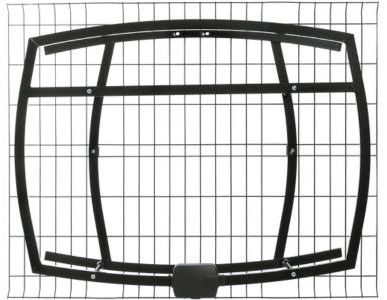
The ClearStream 5 is optimized for Hi-VHF signals, which are still used by some major networks in rural markets. This makes it especially useful in areas where popular stations won’t come in on UHF-only antennas, even when mounted outdoors.
Key Features
- Hi-VHF focused design
- Multi-directional reception
- Attic or outdoor installation
- Integrated diplexer
Pros
- Excellent Hi-VHF performance
- Compact for attic installs
- Complements UHF antennas well
Cons
- Not a UHF-focused long-range antenna
- Limited extreme-distance capability
Bottom Line:
If important local channels still broadcast on Hi-VHF, the ClearStream 5 solves a problem many antennas can’t. It delivers dependable Hi-VHF reception from an attic or outdoor mount and works well on its own or alongside a UHF antenna. For rural areas where UHF-only models miss key stations, this antenna fills a gap that’s easy to overlook.
Best if your area uses Hi-VHF channels and smaller UHF-focused antennas miss important stations.
Antennas Direct ELEMENT – Best Budget Outdoor Antenna
The ELEMENT Uni-Directional Antenna offers directional UHF and VHF reception in a compact, affordable outdoor antenna. It’s designed for rural homes where signals come from one general direction and extreme long-range performance isn’t required.
Key Features
- Directional log-periodic design
- UHF + Hi-VHF reception
- Compact and lightweight
- Attic or outdoor mount
Pros
- Affordable price point
- Simple installation
- Good performance within range
Cons
- Not designed for extreme distances
- Narrower reception pattern
Bottom Line
For buyers who want solid outdoor performance without paying premium prices, the ELEMENT is a practical choice. Its compact, directional design makes it easy to install outdoors or in an attic while still delivering dependable reception at shorter rural distances. If you’re not in deep fringe territory but need a clear upgrade from indoor antennas, this model offers a straightforward and affordable starting point.
Best if you want an affordable outdoor antenna for moderate rural distances and towers in one main direction.
What Else Will You Need to Install It?
Before you buy, check what comes in the box. The same antenna may be sold on its own or in a kit with extra parts.
| Check before buying | What to look for |
|---|---|
| Mount and pole | Does the kit include both? Will the mount fit where you plan to put it? |
| Coax cable | Is cable included, and will it reach your TV? Measure the full cable path first. |
| Amplifier and power | If the kit has an amplifier, check how it gets power and whether the power supply is included. |
| More than one TV | Check whether you need a splitter and extra cable for each TV. |
| Outdoor installation | Allow for grounding parts, weatherproof connections, and help from an installer if needed. |
Compare the full setup cost—not just the antenna price. A cheaper antenna may cost more once you add the missing parts. A kit may save money, but only if you need what it includes.
Fast Fix: If Channels Cut Out
- Try more height first: moving the antenna up even 5–10 feet often improves reception more than buying a larger antenna.
- Check your cable path: Use RG6 coax (the standard TV antenna cable) and, for testing, remove any splitters so the antenna feeds one TV directly.
- Antenna amplifier (booster): Consider one if your coax cable is 50 feet or longer, you use a splitter for two or more TVs, or the signal weakens before reaching your TV. If you live close to the broadcast towers, an amplifier can overload the signal and cause you to lose channels. A mast-mounted preamplifier placed near the antenna usually works better than a plug-in amplifier behind the TV. See my picks for the best TV antenna amplifiers for rural areas.
Your antenna notes and quick fixes, all in one place.
Get the Free TV Antenna Troubleshooting Checklist
A 4-page fill-in guide to keep near your TV.
Fill it in once. Use it when a channel disappears, the picture breaks up, or you need to fix your antenna again.
- Write down your must-have channels, tower direction, and antenna setup
- Follow the quick fixes when a channel goes missing or the picture freezes
- Find and record your best antenna spot so you do not have to start over
- Know when to rescan — and when not to rescan
- Keep the questions to ask an antenna pro before paying for new parts

Hi, I’m Kathy — I’ve helped thousands of readers ditch cable and get their local channels working for good.
Who This Guide Is For
This article is for you if:
- You live 60+ miles from broadcast towers
- Indoor antennas no longer work
- You want free local TV with no monthly bills
- You need a reliable outdoor antenna, not trial-and-error
If that fits your situation, start with the picks below.
If you’re moving away from cable, our overview on how to cut TV cable explains when an outdoor antenna is the smartest long-term choice for rural homes.
How We Selected the Best Outdoor TV Antennas
I did not test every outdoor antenna on the market. Instead, I narrowed this list using a practical, real-world screening process designed for rural and weak-signal homes where indoor antennas consistently fail.
These antennas were not chosen based on marketing claims or exaggerated mile ranges. Each pick addresses a specific rural use case and has documented performance in installations well beyond suburban signal conditions.
To make the list, every antenna had to meet one or more of the following criteria that matter most in rural locations:
- Real-world distance capability beyond 60 miles, based on documented installs—not advertised range numbers
- Proper signal support for UHF, Hi-VHF, or both, depending on how local stations broadcast
- Antenna design matched to tower layout, including directional, multi-directional, and omni designs
- Installation flexibility, allowing for attic, roof, or pole mounting as terrain and obstructions require
I also prioritized antennas with long track records, consistent user feedback over time, and designs commonly recommended by antenna installers and broadcast engineers for rural homes.
The result is a focused list that covers distinct rural scenarios—so you can choose the right antenna based on your distance, terrain, and tower layout, not trial-and-error or marketing hype.
Helpful Buying Tips (Read This Before You Choose)
These quick points can save you time and frustration:
Multi-directional doesn’t mean stronger—it means flexible. These antennas trade raw gain for the ability to receive signals from multiple directions, which matters when towers aren’t clustered.
Distance matters more than brand. If you’re 60–70+ miles from towers, antenna size, height, and directionality matter more than the name on the box.
Distance alone doesn’t determine the right antenna. Even in the same rural area, homes vary widely in tower direction, signal type (UHF vs Hi-VHF), number of TVs, and mounting options.
Know whether your channels are UHF or VHF. Not sure what your area can receive? This quick guide explains the local channels and classic-TV subchannels antennas usually pull in—and why it varies by ZIP code.
Height beats amplification. Raising an antenna even 5–10 feet often improves reception more than adding an amplifier.
Directional isn’t bad—it’s precise. If towers are in one direction, a directional antenna almost always delivers a cleaner, more stable signal than omni designs.
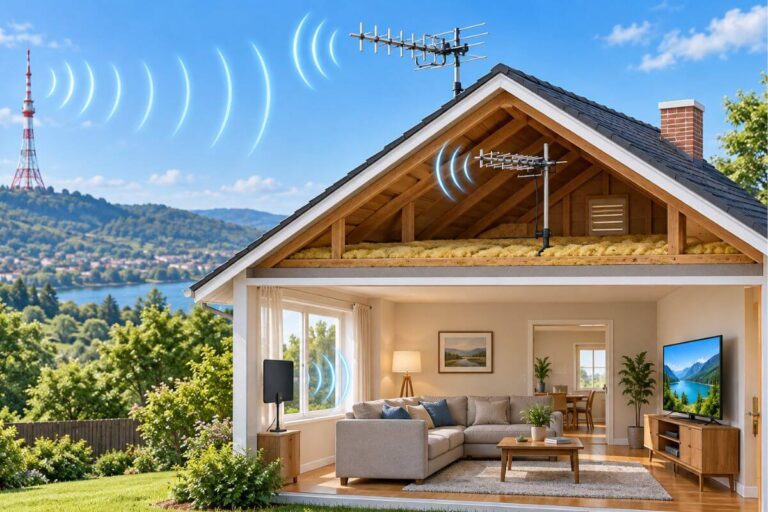
Attic installs can work — but only up to a point. Attics reduce signal strength. If you’re in a deep rural area, outdoor mounting almost always performs better. If you’re deciding between attic and roof placement, compare an outdoor vs attic TV antenna before you commit.
Choosing the Right Outdoor Antenna for Your Situation
Long Distance or Weak Signals
If your towers are far away and mostly in one direction, choose a strong directional antenna.
- Televes DAT BOSS Mix LR: Best for weak UHF and Hi-VHF signals
- Winegard HD8200A: Best when you also need Low-VHF channels
- DB8-e Bowtie: Best for distant UHF towers in one or two directions
Trees or Hills
Trees, hills, and buildings can block or weaken TV signals. Mounting the antenna higher often helps more than adding an amplifier.
- Televes DAT BOSS Mix LR: A strong choice when towers are mainly in one direction
- DB8-e Bowtie: A good choice when distant UHF towers are in one or two directions
- ClearStream 4V: A simpler option for moderate distances
No antenna can guarantee reception when a large hill completely blocks the signal.
Moderate Rural Distance
If your towers are about 30–60 miles away, you may not need the largest antenna.
- ClearStream 4V: Best overall for strong UHF and Hi-VHF reception
- Antennas Direct ELEMENT: Best lower-cost choice when towers are in one direction
Multiple TVs
Splitting the signal between TVs can make it weaker.
The ClearStream MAX-XR Complete includes the equipment needed to connect as many as three TVs.
Antenna Types Explained
The best antenna type depends on where your broadcast towers are located.
Towers in one direction: Choose a directional antenna. It focuses on one area and often provides the strongest signal for rural homes.
Towers in two or more directions: Choose a multi-directional antenna. It can receive signals across a wider area with less exact aiming.
Towers surrounding your home: An omnidirectional antenna may work well. These antennas receive signals from all directions but work best when signals are already fairly strong.
Multiple TVs: Connecting more than one TV can weaken the signal. A distribution amplifier may help replace the signal lost through splitters and long cables.
VHF channels: Check whether your local stations use Hi-VHF or Low-VHF. Not every outdoor antenna receives both.
Tower direction and channel frequency matter more than the range number printed on the box.
Where Should You Mount an Outdoor TV Antenna?
For the best results, mount your outdoor TV antenna as high as practical with a clear line of sight toward broadcast towers. Roof-level or above usually works best because trees, buildings, and terrain can block signals before they reach your antenna.
Even a small increase in height can noticeably improve how many channels you receive.
If you want exact height guidelines, this guide explains how high your outdoor TV antenna should be for the best signal. If your reception drops or cuts out after setup, this breakdown explains why outdoor antennas lose signal and what patterns to look for.
Frequently Asked Questions
What is the best outdoor TV antenna for rural areas?
For most rural homes, the ClearStream 4V is my best overall pick because it receives UHF and Hi-VHF signals without requiring extremely precise aiming. If your signals are very weak and your towers are mainly in one direction, the Televes DAT BOSS Mix LR is the stronger choice.
How far can an outdoor TV antenna realistically reach?
An outdoor antenna can sometimes receive stations 70 miles away, but that distance is not guaranteed. Tower height, hills, trees, buildings, antenna height, and tower direction all affect reception. For distant towers in one direction, a large directional antenna usually works best. Before buying, check your tower distance and direction.
Is an amplifier required for outdoor antennas?
Not always. An amplifier may help with a cable longer than 50 feet or when one antenna feeds several TVs. It cannot create a signal that the antenna does not receive. Antenna height, placement, and aiming matter more.
Can I install an outdoor antenna in the attic?
Yes, if your signals are fairly strong. Metal roofing, radiant barriers, thick walls, and insulation can weaken reception. An outdoor roof or pole mount usually works better in rural and weak-signal areas.
Do outdoor antennas work without internet?
Yes. An outdoor antenna receives free TV signals from local broadcast towers. You do not need internet, cable, or a monthly subscription.
Why do indoor antennas fail in rural areas?
Walls, roofing, wiring, trees, and low placement can weaken TV signals. Indoor antennas also have less room to capture weak signals. Mounting a larger antenna higher and outdoors usually improves rural reception.
Wrap Up
The best outdoor TV antenna is the one that matches your tower distance, tower direction, and local channel frequencies.
For many rural homes, the ClearStream 4V is the best overall choice. Choose the Televes DAT BOSS Mix LR for very weak signals from one direction. Choose the Winegard HD8200A if you need Low-VHF channels.
Mount your antenna as high as you safely can. If channels cut out, check the antenna direction, cable, and splitters before buying another antenna.
Love a good Who done it? An outdoor antenna may pick up channels that air classic mysteries. Browse our 60s detective shows and 70s detective shows guides for ways to watch, then check your local TV listings for showtimes.